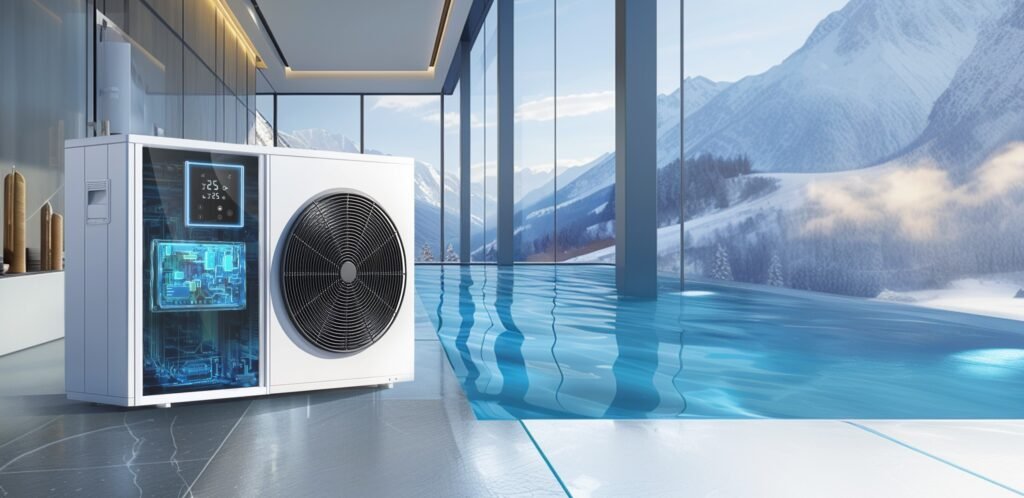
Against the backdrop of global carbon neutrality and the rising demand for energy-efficient living, the pool heat pump market has entered a period of steady growth. As the “brain” of pool heat pump systems, high-performance control boards are becoming a key competitive factor for manufacturers. This article will analyze the latest market trends and explain how professional control boards drive product upgrades.
1. Market Overview: Steady Growth Driven by Policy and Demand
The pool heat pump market is experiencing robust expansion globally, fueled by multiple favorable factors:
Market Scale and Growth Trajectory
According to IMARC Group, the global pool heat pump market reached USD 5.1 billion in 2024 and is projected to hit USD 7.1 billion by 2033, with a compound annual growth rate (CAGR) of 3.67% from 2025 to 2033 . Another report shows that the market will maintain an 11.7% CAGR from 2025 to 2031, reflecting strong industry resilience . China, as the world’s largest producer and exporter of pool heat pumps, plays a pivotal role in the global supply chain, with its 2024 market scale reaching RMB 2.136 billion and expected to grow to RMB 2.365 billion in 2025 .
Core Driving Forces
- Policy Incentives: Governments worldwide have introduced subsidies, tax breaks, and green loan policies to promote renewable energy adoption. For example, the EU’s ERP directive and the U.S. Energy Star program have raised energy efficiency thresholds for pool heat pumps, accelerating the replacement of traditional heating equipment .
- Demand Expansion: The growth of high-end residential villas, hotels, and wellness resorts has boosted demand for constant-temperature pools. In emerging economies, the expanding middle class is making private pools a symbol of improved living standards .
- Energy Efficiency Needs: Compared with electric or gas heating, pool heat pumps have a COP (Coefficient of Performance) of over 5.0, reducing energy consumption by 60%-75% . This advantage has become a key purchasing criterion for global buyers.
2. Key Market Trends: Control Boards Define Product Competitiveness
The market is shifting toward higher efficiency, smarter operation, and stronger integration, and control boards are at the heart of these transformations:
Trend 1: Energy Efficiency Upgrades Mandate Precision Control
With increasingly stringent energy efficiency standards (e.g., the EU’s 2025 ERP update requiring higher COP), traditional fixed-speed systems are being phased out. Our pool heat pump control boards feature advanced variable-frequency control algorithms that dynamically adjust compressor speed based on ambient temperature and water temperature differences, improving system COP by up to 15% compared to conventional control solutions . They also support real-time monitoring of energy consumption, helping products meet Energy Star and ERP Class A standards.
Trend 2: Smart IoT Integration Becomes a Must-Have
In 2024, sales of smart pool heat pumps with remote control and energy monitoring functions grew by 22%, far exceeding the industry average . Our control boards are equipped with IoT modules compatible with Modbus and MQTT protocols, enabling seamless connection to cloud platforms. Users can adjust water temperature, set operating schedules, and receive fault alerts via mobile apps—an essential feature for commercial clients such as hotels and water parks managing multiple devices . The boards also have automatic fault diagnosis and self-recovery capabilities, reducing after-sales maintenance costs by 30%.
Trend 3: Low-Temperature Adaptability Expands Market Boundaries
To penetrate colder regions like Northern Europe and Canada, pool heat pumps need stable operation at temperatures as low as -15°C. Our control boards integrate intelligent defrosting technology that uses multi-sensor data (ambient temperature, exhaust temperature, frost thickness) to trigger defrosting only when necessary, shortening defrosting time by over 20% and ensuring efficient heating even in harsh winters . This technology has helped our clients expand their market share in high-latitude regions by 25% year-over-year.
3. Our Advantage: Control Boards Tailored for Global Markets
As a core component supplier for leading pool heat pump manufacturers worldwide, our control boards address the specific needs of international markets:
- Global Compliance: Certified by CE, UL, and RoHS, our products meet the regulatory requirements of the EU, U.S., and Southeast Asian markets, simplifying our clients’ product certification processes.
- High Compatibility: Designed to work with major compressor brands (Copeland, Danfoss) and refrigerant types (R32, R290), they support both air-source and water-source heat pump systems, adapting to diverse product lines.
- Customized Solutions: We offer flexible firmware customization for commercial and residential scenarios—for example, adding peak-valley electricity pricing adaptation for European users and multi-device linkage control for large-scale water parks.
Conclusion
The global pool heat pump market is entering a quality-driven era, where control boards are no longer just auxiliary components but core assets determining product competitiveness. By combining energy efficiency optimization, smart IoT integration, and low-temperature adaptability, our control boards help manufacturers seize opportunities in policy-driven and demand-driven markets.
Whether you are developing Energy Star-compliant residential products or large commercial systems for resorts, we provide the “intelligent core” to accelerate your global market expansion.