Overview: The Heat Pump Industry Enters a High-Growth Era Under Global Carbon Neutrality
Against the global carbon neutrality backdrop, the heat pump industry has stepped into a fast-growth track, becoming a pivotal force in the global energy transition and low-carbon development. As a high-efficiency energy-saving technology that realizes heat transfer between different temperature zones, heat pumps can replace traditional fossil energy heating and cooling equipment, effectively reducing carbon dioxide emissions and aligning with the core goals of carbon neutrality strategies in various countries.
Market data further verifies the strong growth momentum of the industry. According to Mordor Intelligence, the global heat pump market size reached a significant milestone, hitting 83.66 billion USD in 2025. Driven by multiple favorable factors such as policy support and technological innovation, the market is expected to maintain steady growth in the next five years, rising to 131.67 billion USD by 2030. This represents a compound annual growth rate (CAGR) of 9.49% during the period 2025-2030, highlighting the huge market potential and broad development prospects of the heat pump industry.
Core Growth Drivers: Policy Escort and Technological Breakthroughs
Policy Support: A Strong Backing for Industry Development in Europe and North America
The first core driver of the heat pump industry’s growth lies in the strong policy support from major regions such as Europe and North America. Under the framework of global carbon neutrality, governments of various countries have recognized the important role of heat pumps in energy conservation and emission reduction, and have introduced a series of supportive policies to stimulate market demand.
In the European Union, heat pumps are explicitly listed as key core technologies to achieve carbon neutrality goals. The EU’s “Renewable Energy Directive” and “Green Deal” have set clear targets for the popularization of heat pumps, requiring member states to gradually phase out traditional fossil energy heating systems and increase the penetration rate of renewable energy heating equipment. To this end, many European countries have launched generous subsidy programs and tax incentive policies. For example, Germany provides direct subsidies for residents to install heat pumps, covering up to 30% of the installation cost; France implements tax rebates for heat pump purchases and exempts related energy consumption taxes.
In North America, the United States and Canada have also stepped up policy support for the heat pump industry. The U.S. Inflation Reduction Act includes special provisions for heat pump promotion, providing tax credits for households and businesses that adopt high-efficiency heat pumps. Canada has incorporated heat pumps into its national renewable energy development strategy, supporting the popularization of heat pumps in residential and commercial buildings through federal and provincial-level subsidy policies. These policy measures have greatly lowered the threshold for consumers and enterprises to adopt heat pumps, effectively boosting market demand.
Technological Breakthroughs: Enhancing Core Competitiveness and Expanding Application Boundaries
The second core driver is the continuous breakthroughs in heat pump technology, which have significantly improved the performance and energy efficiency of products, and expanded the scope of application. Among them, the upgrading of inverter compressors and the optimization of intelligent control systems are the key technological highlights driving industry growth.
Traditional heat pumps often face problems such as reduced heating capacity and low energy efficiency in low-temperature environments, which restricts their popularization in high-latitude and cold regions. The upgraded inverter compressors adopt advanced frequency conversion technology, which can adjust the operating speed in real time according to the ambient temperature and user demand. This not only enhances the heating performance of heat pumps in low-temperature environments (even at -20℃ or lower, they can still operate stably and efficiently), but also reduces energy consumption and improves the stability of the system.
In addition, the application of intelligent control technology has further optimized the energy efficiency of heat pumps. By integrating Internet of Things (IoT) technology, sensors and intelligent algorithms, heat pump systems can realize real-time monitoring of indoor and outdoor temperature, humidity and other parameters, and automatically adjust operating parameters to achieve the optimal energy-saving effect. At the same time, users can remotely control the heat pump through mobile apps, improving the convenience of use. These technological upgrades have not only improved the user experience of heat pumps, but also enhanced their competitiveness compared with traditional heating and cooling equipment.
Application Expansion: Beyond Construction, Exploring New Growth Engines in Industry and Agriculture
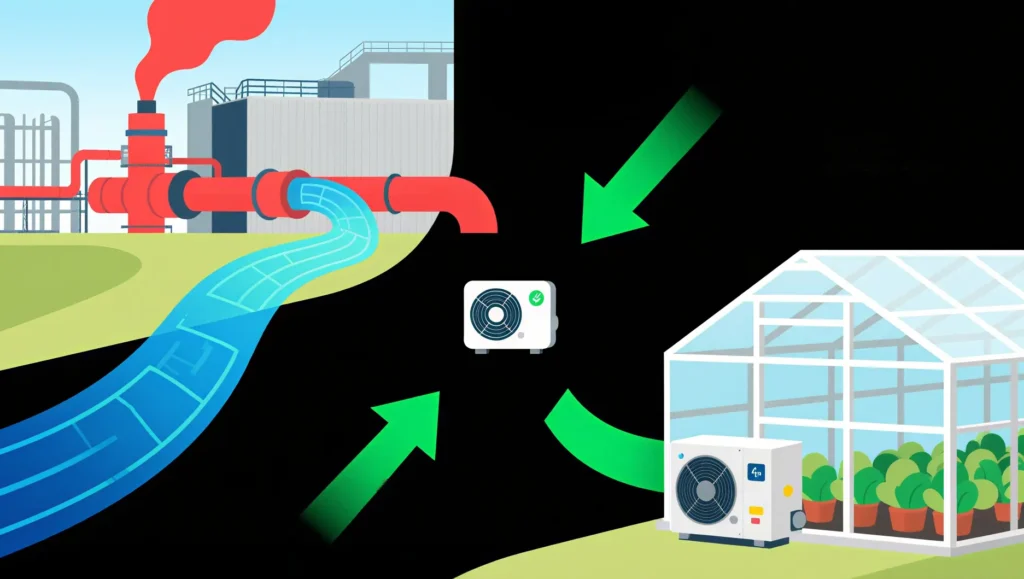
In the past, the heat pump industry was mainly concentrated in the construction sector, used for residential and commercial building heating, cooling and domestic hot water supply. In recent years, with the continuous improvement of technology and the deepening of low-carbon transformation in various industries, the demand for heat pumps in new application scenarios such as industrial waste heat recovery and agricultural drying/glasshouse temperature control has grown rapidly, becoming a new growth point for the industry.
Industrial Waste Heat Recovery: Tapping into the Huge Potential of Low-Carbon Production
Industry is a major energy consumer, and a large amount of waste heat is generated during the production process. According to relevant data, nearly 50% of industrial energy consumption is emitted into the environment as waste heat, which not only causes a huge waste of energy, but also brings environmental pressure. Heat pumps, with their high-efficiency heat transfer characteristics, can effectively recover and reuse industrial waste heat, converting low-grade waste heat into high-grade heat energy for production processes such as heating, drying and power generation.
At present, heat pump technology has been widely applied in industries such as steel, cement, chemical and food processing. For example, in the steel industry, heat pumps can recover waste heat from blast furnace flue gas and converter steam, and use it for heating workshops and preheating raw materials; in the food processing industry, heat pumps can recover waste heat from cooking and sterilization processes to provide heat for drying food. The application of heat pumps in industrial waste heat recovery not only helps enterprises reduce energy consumption and production costs, but also reduces carbon emissions, which is highly in line with the needs of industrial low-carbon transformation, and thus has huge market potential.
Agricultural Applications: Empowering Green Agriculture with Precision Temperature Control
In the agricultural field, heat pumps are increasingly used in scenarios such as agricultural product drying and greenhouse temperature control, bringing new opportunities for the development of green agriculture. For agricultural product drying, traditional drying methods often rely on fossil energy or natural drying, which have problems such as high energy consumption, low efficiency, and unstable product quality. Heat pump drying technology has the advantages of energy saving, environmental protection, and precise control of temperature and humidity. It can dry agricultural products such as grains, fruits, vegetables and medicinal materials in a closed environment, ensuring the quality of products while reducing energy consumption and pollutant emissions.
In terms of greenhouse temperature control, heat pumps can realize precise regulation of greenhouse temperature and humidity, creating a suitable growth environment for crops. Compared with traditional heating methods such as coal-fired boilers, heat pump greenhouse temperature control systems are more energy-saving and environmentally friendly, and can effectively reduce the impact of agricultural production on the environment. With the continuous development of modern agriculture and the increasing demand for high-quality agricultural products, the application of heat pumps in the agricultural field is expected to achieve further growth.
Future Outlook: Sustained Growth Driven by Multiple Factors
Looking ahead, the heat pump industry will continue to maintain a high-speed growth trend driven by the dual pull of policy and market, as well as the continuous iteration of technology. On the one hand, with the deepening of global carbon neutrality efforts, more countries and regions are expected to introduce supportive policies for the heat pump industry, further expanding the global market space. On the other hand, technological innovations such as the development of more efficient heat pump compressors, the integration of renewable energy (such as solar energy and wind energy) with heat pump systems, and the improvement of intelligent and digital levels will continue to enhance the performance and application scope of heat pumps.
At the same time, the continuous expansion of application scenarios in industry, agriculture and other fields will provide a steady stream of growth momentum for the industry. It is expected that in the next 5-10 years, the heat pump industry will become an important pillar of the global low-carbon energy industry, bringing more opportunities for related enterprises and promoting the process of global carbon neutrality.